Product Upload Automation: The Smart Way to Scale eCommerce Operations with AI
January 20, 2026
Product Upload Automation is transforming how modern eCommerce businesses manage catalogs, scale marketplaces, and maintain accuracy across platforms. As product data grows in volume and complexity, manual uploads are no longer sustainable. This blog explores how product upload automation works, why it matters, how AI enhances it, and how businesses can achieve faster growth, fewer errors, and better customer experiences through intelligent automation.
What Is Product Upload Automation?
Product upload automation is the process of using software, workflows, and AI-driven tools to automatically upload, update, and manage product listings across eCommerce platforms, marketplaces, and internal systems.
Instead of manually entering:
- Product titles
- Descriptions
- Images
- Pricing
- Inventory
- Attributes
Automation handles these tasks at scale with consistency and speed.
According to industry studies, manual product data entry can consume up to 30–40% of eCommerce operational time, making automation a critical efficiency driver.
Why Product Upload Automation Matters in Today’s eCommerce Landscape
The modern eCommerce ecosystem is complex. Businesses sell across:
- Websites
- Marketplaces
- Social commerce platforms
- International regions
Product upload automation matters because it:
- Reduces human error
- Saves operational costs
- Speeds up time-to-market
- Improves data accuracy
- Enables scalable growth
As Jeff Bezos once stated,
“What’s dangerous is not to evolve.”
In eCommerce, evolution begins with automation.
The Cost of Manual Product Uploads
Manual product uploads lead to:
- Inconsistent product data
- Delayed launches
- Pricing mismatches
- Inventory errors
- Poor customer experience
Research from IBM shows that bad data costs businesses an average of $3.1 trillion annually, and product data errors are a major contributor in retail and eCommerce.
Product upload automation directly addresses this challenge.
How Product Upload Automation Works
Step 1: Centralized Product Data
All product information is stored in a structured format such as:
- PIM systems
- ERP platforms
- Databases
- Cloud storage
Step 2: Data Mapping
Product attributes are mapped to platform-specific requirements including:
- Category structures
- Attribute formats
- Image specifications
Step 3: Automated Validation
Rules check for:
- Missing fields
- Incorrect formats
- Duplicate entries
- Compliance issues
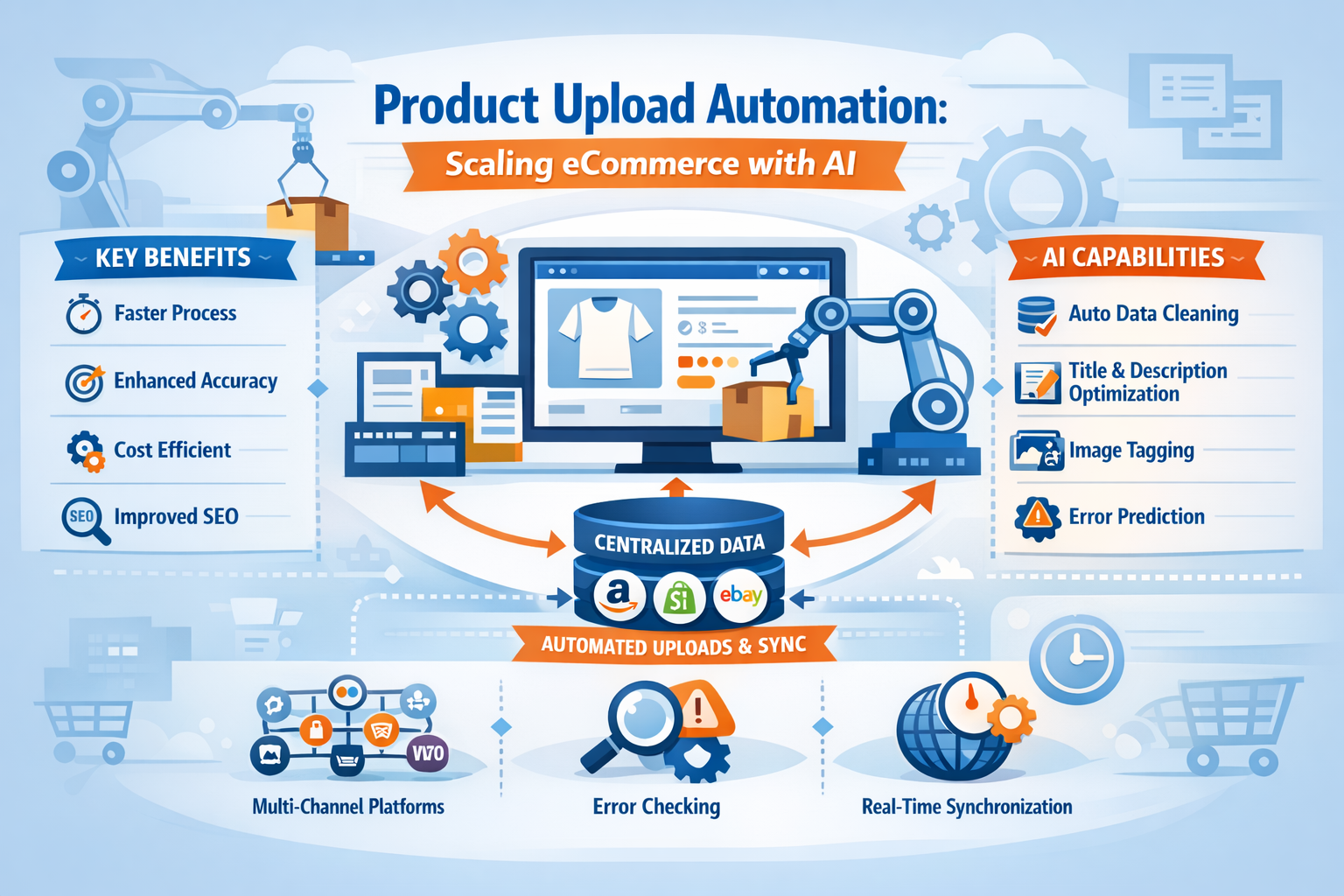
Step 4: Automated Upload and Sync
Products are uploaded and synchronized across platforms automatically, ensuring consistency.
AI Integration in Product Upload Automation
Artificial Intelligence elevates product upload automation from rule-based execution to intelligent decision-making.
AI-Powered Enhancements
Smart Data Cleansing
AI identifies inconsistencies, duplicates, and errors in product data before upload.
Automated Content Optimization
AI generates and optimizes:
- Product titles
- Descriptions
- Bullet points
- SEO attributes
Image Recognition and Tagging
AI analyzes images to auto-assign categories, attributes, and tags.
Predictive Error Detection
Machine learning predicts potential listing failures based on historical data.
According to McKinsey, AI-driven automation can improve operational efficiency by up to 40%.
SEO, AEO, and GEO Benefits of Product Upload Automation
SEO Benefits
- Consistent product metadata
- Optimized titles and descriptions
- Improved crawlability
- Structured data accuracy
AEO Benefits
- Clear product information for answer engines
- Better eligibility for rich snippets
- Improved voice search compatibility
GEO Benefits
- Content structured for AI-generated search results
- Context-rich product information
- Authority signals through data accuracy
Search engines and AI systems reward clarity, structure, and reliability.
Who Should Use Product Upload Automation?
- eCommerce brands
- Multi-vendor marketplaces
- Dropshipping businesses
- Retailers with large catalogs
- Businesses expanding internationally
If your product count exceeds a few hundred SKUs, automation is no longer optional.
How Product Upload Automation Improves Customer Experience
Accurate and timely product data ensures:
- Correct pricing
- Up-to-date availability
- Clear descriptions
- Trustworthy listings
According to Salesforce, 88% of customers say experience is as important as the product itself.
Automation ensures consistency across every touchpoint.
Compliance, Accuracy, and Governance
- Platform compliance
- Category guidelines
- Attribute validation
- Regional requirements
This reduces listing rejections and account suspensions on major marketplaces.
Real Business Impact of Product Upload Automation
- Faster product launches
- Reduced operational costs
- Higher listing accuracy
- Improved SEO performance
- Scalable growth
Gartner reports that organizations using intelligent automation outperform competitors by 25% in operational efficiency.
Common Challenges and How Automation Solves Them
Challenge: Platform-Specific Requirements
Solution: Automated data mapping and templates
Challenge: Human Errors
Solution: AI validation and rule-based checks
Challenge: Scaling Product Volume
Solution: Bulk uploads and automated workflows
Future Trends in Product Upload Automation
- AI-generated product content with human review
- Real-time inventory synchronization
- Voice-search optimized product data
- Multilingual automation for global expansion
By 2027, over 70% of eCommerce operations will rely on AI-powered automation, according to IDC.
Frequently Asked Questions
What is product upload automation?
+It is the automated process of uploading and managing product data across eCommerce platforms using software and AI.
Is product upload automation suitable for small businesses?
+Yes. It helps small businesses scale efficiently without increasing operational overhead.
How does AI improve product upload automation?
+AI enhances accuracy, content quality, error detection, and SEO optimization.
Does product upload automation help with SEO?
+Yes. It ensures consistent metadata, structured data, and optimized product listings.
Can automation handle bulk product uploads?
+Yes. Automation is designed for high-volume and multi-platform product management.
Conclusion
Product Upload Automation is no longer just an operational improvement; it is a strategic advantage. In a competitive digital commerce environment, businesses that automate product uploads gain speed, accuracy, scalability, and search visibility.
With AI integration, product upload automation evolves into an intelligent system that learns, optimizes, and adapts. It reduces costs, enhances customer trust, and supports sustainable growth.
In the era of digital commerce and AI-powered search, automation is not about replacing people—it is about empowering businesses to grow smarter, faster, and stronger.