Digital Marketing: The Engine Powering Modern Business Growth in an AI-Driven World
December 23, 2025
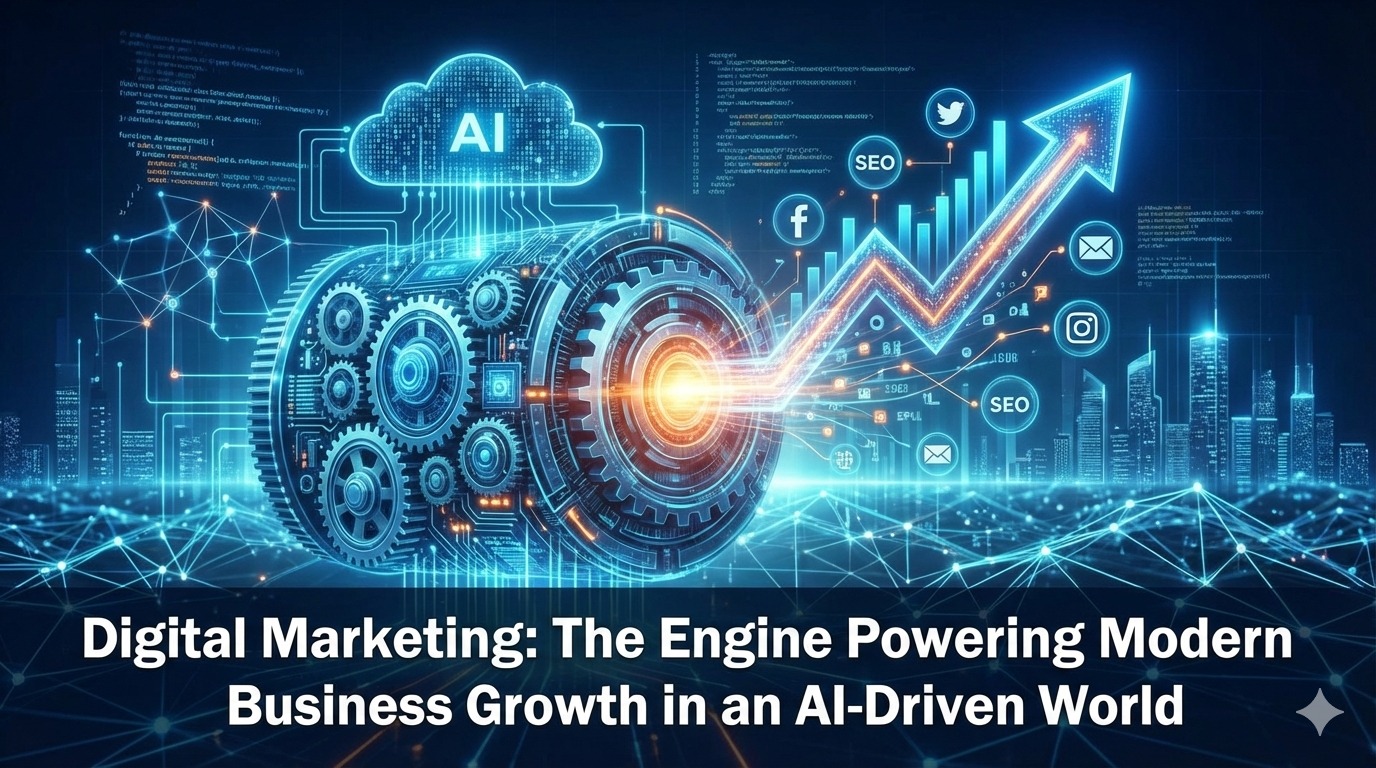
Digital Marketing has become the foundation of how modern businesses attract, engage, and convert customers in an increasingly competitive online environment. From search engines and social media to automation, analytics, and artificial intelligence, digital marketing now connects brands with audiences at scale while delivering measurable business outcomes.
This comprehensive guide explores what digital marketing truly means today, why it matters more than ever, how AI is reshaping strategies, and how businesses can build sustainable growth through data-driven digital marketing ecosystems.
What Is Digital Marketing?
Digital marketing refers to the use of digital channels, platforms, and technologies to promote products, services, and brands to targeted audiences. Unlike traditional marketing, digital marketing is measurable, scalable, and adaptive in real time.
Core digital marketing channels include:
- Search engines
- Websites and landing pages
- Social media platforms
- Email marketing
- Content marketing
- Paid advertising
- Marketing automation tools
According to Statista, global digital advertising spend crossed $600 billion, highlighting how digital marketing has become the dominant force in brand visibility and customer acquisition.
Why Digital Marketing Matters More Than Ever
Consumer behavior has permanently shifted online. People research, compare, and purchase products digitally before ever speaking to a business.
Digital marketing matters because it:
- Reaches audiences where they already are
- Enables precise targeting and personalization
- Provides measurable ROI
- Scales across regions and markets
- Builds long-term brand trust
As Bill Gates famously said,
“If your business is not on the internet, then your business will be out of business.”
Digital marketing ensures businesses remain visible, relevant, and competitive.
The Core Pillars of Digital Marketing
Search Engine Optimization (SEO)
SEO ensures that websites rank higher in organic search results, driving long-term traffic without ongoing ad spend.
Key SEO elements include:
- Keyword optimization
- Technical SEO
- Content relevance
- User experience
- Link authority
Google processes over 8.5 billion searches per day, making SEO one of the most powerful digital marketing channels.
Content Marketing
Content marketing focuses on creating valuable, informative, and engaging content that educates and builds trust.
Types of content include:
- Blogs
- Guides
- Videos
- Case studies
- Infographics
According to HubSpot, content marketing generates 3x more leads than traditional marketing at 62% lower cost.
Social Media Marketing
Social platforms allow brands to engage directly with audiences in real time.
Benefits include:
- Brand awareness
- Community building
- Customer engagement
- Direct communication
With over 4.9 billion social media users globally, social media has become a digital marketing necessity.
Paid Advertising (PPC)
Paid ads provide instant visibility through platforms like search engines and social media.
Advantages include:
- Immediate traffic
- Audience targeting
- Budget control
- Performance tracking
When managed correctly, paid campaigns complement organic digital marketing strategies.
Email Marketing
Email remains one of the highest ROI channels in digital marketing.
Data shows that email marketing delivers an average ROI of $36 for every $1 spent.
It is used for:
- Lead nurturing
- Customer retention
- Promotions
- Personalized communication
AI Integration in Digital Marketing
Artificial Intelligence has transformed digital marketing from reactive to predictive.
How AI Enhances Digital Marketing
- AI-Driven Audience Targeting:
- Predictive Analytics:
- Content Personalization:
- Chatbots and Conversational Marketing:
- Marketing Automation:
- Email sequences
- Campaign optimization
- Lead scoring
- A/B testing
AI analyzes user behavior, interests, and intent to deliver hyper-relevant messaging.
Machine learning forecasts trends, conversions, and customer lifetime value.
AI adapts content based on user preferences, location, and behavior.
AI chatbots provide 24/7 customer support and lead qualification.
AI automates repetitive tasks such as:
McKinsey reports that AI-powered marketing can increase revenue by up to 15% while reducing costs by 30%.
Digital Marketing and the Who-How-Why Framework
Who Is Digital Marketing For?
Digital marketing benefits:
- Startups
- SMEs
- Enterprises
- eCommerce businesses
- B2B and B2C companies
- Service providers
How Digital Marketing Works
It works by combining:
- Data collection
- Audience analysis
- Strategy execution
- Continuous optimization
Why Digital Marketing Is Effective
Because it is:
- Data-driven
- Customer-centric
- Measurable
- Scalable
- Adaptive
This directly aligns with Google’s Helpful Content guidelines.
GEO and AEO in Digital Marketing
Generative Engine Optimization (GEO)
GEO focuses on optimizing content for AI-powered search experiences such as:
- AI search summaries
- Voice assistants
- Chat-based search engines
Clear structure, authoritative tone, and factual accuracy help content perform better in AI responses.
Answer Engine Optimization (AEO)
AEO ensures content answers specific user questions directly.
Digital marketing content optimized for AEO:
- Uses clear headings
- Provides concise answers
- Includes FAQs
- Uses natural language
Measuring Digital Marketing Success
Key performance indicators include:
- Organic traffic
- Conversion rate
- Engagement metrics
- Customer acquisition cost
- Return on investment
Advanced analytics tools powered by AI provide real-time insights for continuous improvement.
Challenges in Digital Marketing and How to Overcome Them
Common challenges:
- High competition
- Algorithm changes
- Content saturation
- Rising ad costs
Solutions:
- Focus on quality over quantity
- Use AI for insights
- Invest in long-term SEO
- Build omnichannel strategies
The Future of Digital Marketing
Digital marketing is evolving rapidly with trends such as:
- AI-generated content with human oversight
- Voice and visual search
- Predictive personalization
- First-party data strategies
- Privacy-focused marketing
According to Gartner, 80% of marketers will rely on AI for real-time personalization by 2026.
Frequently Asked Questions
Conclusion
Digital Marketing is no longer an optional business activity; it is the engine driving visibility, growth, and customer engagement in the digital age. With the integration of AI, automation, and data analytics, digital marketing has evolved into a powerful, intelligent ecosystem that adapts to changing consumer behavior.
Businesses that invest in strategic digital marketing gain a sustainable competitive advantage, deeper customer relationships, and measurable long-term growth.
In a world driven by technology and data, digital marketing is not just about being online—it is about being discoverable, relevant, and trusted.