CRM Software Development: Building Intelligent Customer Relationships for Scalable Business Growth
December 29, 2025
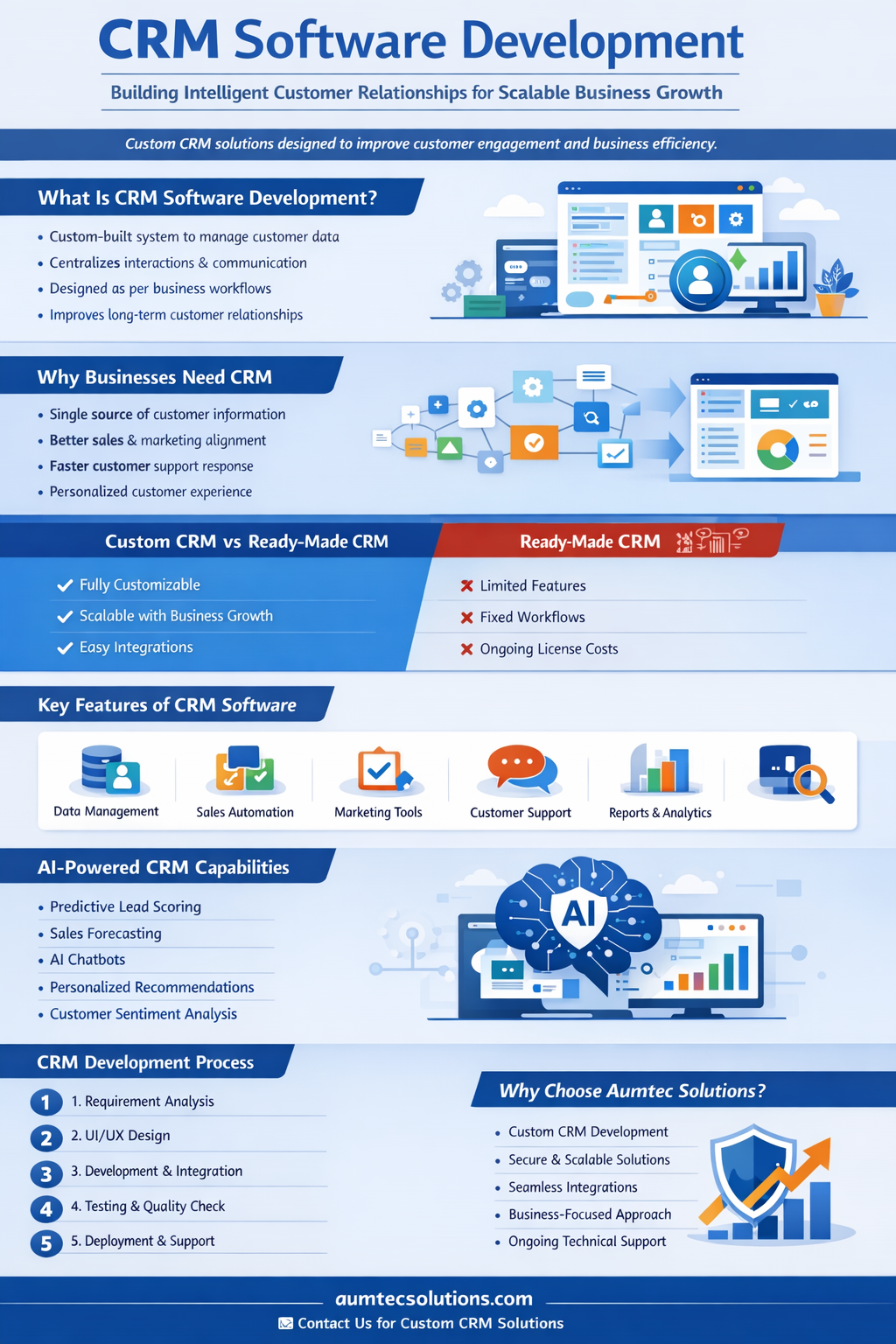
CRM Software Development has become a cornerstone of modern digital transformation, enabling businesses to centralize customer data, automate workflows, and deliver personalized experiences at scale. This blog explains what CRM software development is, why it matters, how AI is reshaping it, and how businesses can leverage custom CRM systems to drive growth, efficiency, and long-term customer value.
In this guide, you will learn how CRM development works, who it is for, why custom CRM solutions outperform off-the-shelf tools, and how AI-powered CRM platforms are redefining sales, marketing, and customer service.
What Is CRM Software Development?
CRM software development is the process of designing, building, customizing, and maintaining Customer Relationship Management systems tailored to a business’s unique processes, customers, and growth goals.
Unlike generic CRM platforms, custom CRM software is developed to match:
- Business workflows
- Sales cycles
- Customer engagement strategies
- Data security requirements
- Industry-specific compliance
A well-developed CRM acts as a single source of truth for customer data across sales, marketing, support, and operations.
According to Salesforce research, CRM systems increase sales productivity by up to 34% and improve customer retention by more than 27%.
Why CRM Software Development Matters More Than Ever
Customer expectations have changed. Buyers now expect:
- Personalized interactions
- Faster responses
- Consistent communication across channels
- Data-driven recommendations
Without a robust CRM, these expectations are difficult to meet.
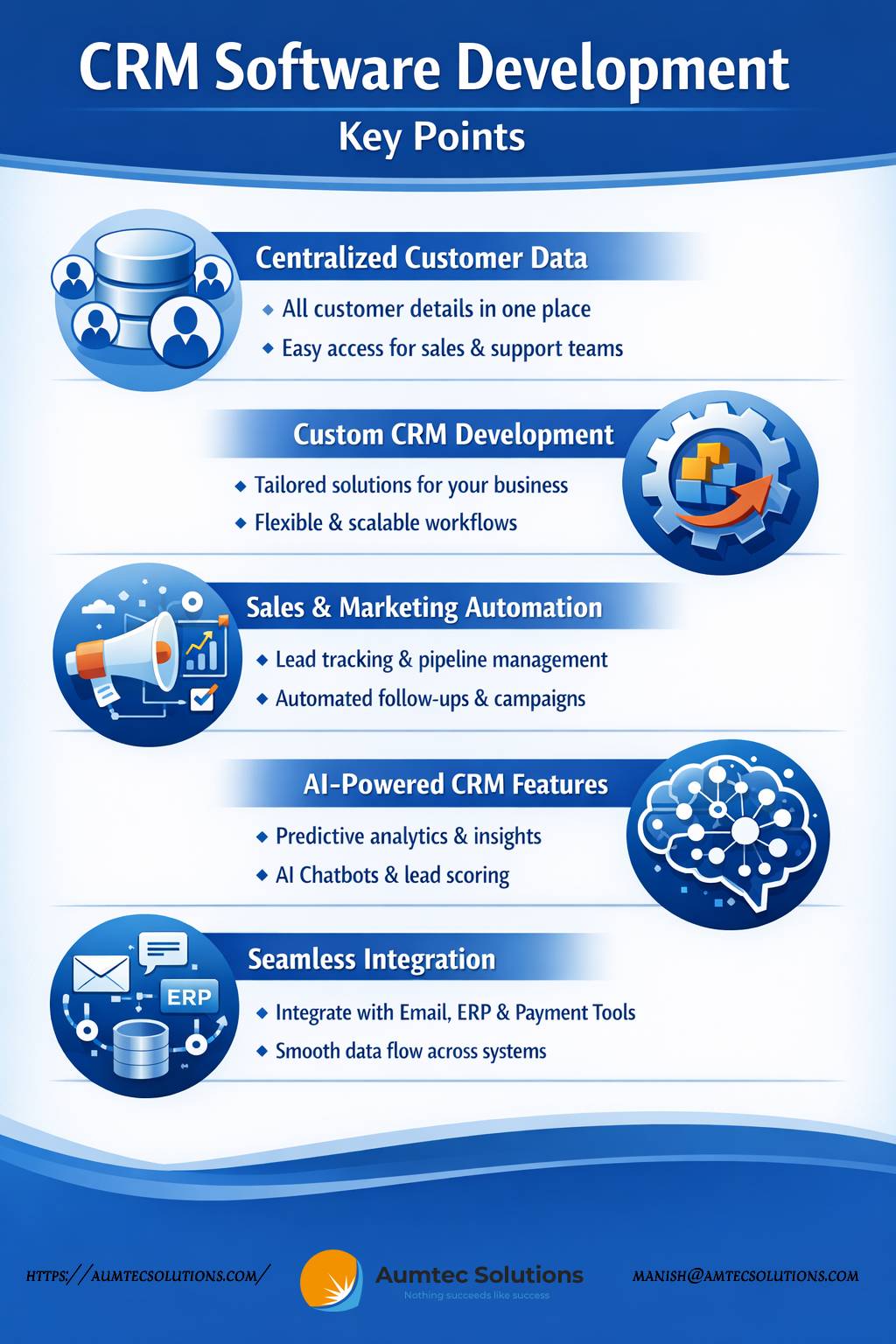
CRM Software Development enables businesses to:
- Track every customer interaction
- Eliminate data silos
- Automate repetitive tasks
- Improve decision-making through analytics
- Build long-term customer relationships
As Peter Drucker famously said,
“The purpose of a business is to create and keep a customer.”
CRM systems are the technology backbone that makes this possible in a digital world.
Custom CRM vs Off-the-Shelf CRM Platforms
Many businesses start with ready-made CRM tools. While useful initially, they often create limitations over time.
Limitations of Off-the-Shelf CRM
- Unnecessary features that slow adoption
- Limited customization
- High recurring licensing costs
- Restricted integrations
- Data ownership concerns
Advantages of Custom CRM Software Development
- Tailored workflows and dashboards
- Seamless integration with existing systems
- Scalable architecture
- Enhanced security and compliance
- Full ownership of data and features
Gartner reports that over 70% of CRM implementations fail due to poor alignment with business processes. Custom development solves this gap.
Core Features of Modern CRM Software
A robust CRM system typically includes:
Customer Data Management
- Centralized customer profiles
- Interaction history
- Purchase and communication records
Sales Automation
- Lead management
- Opportunity tracking
- Pipeline forecasting
- Automated follow-ups
Marketing Automation
- Campaign tracking
- Segmentation
- Email and messaging automation
Customer Support Management
- Ticketing systems
- SLA tracking
- Knowledge base integration
Analytics and Reporting
- Performance dashboards
- Sales and revenue insights
- Customer behavior analytics
AI Integration in CRM Software Development
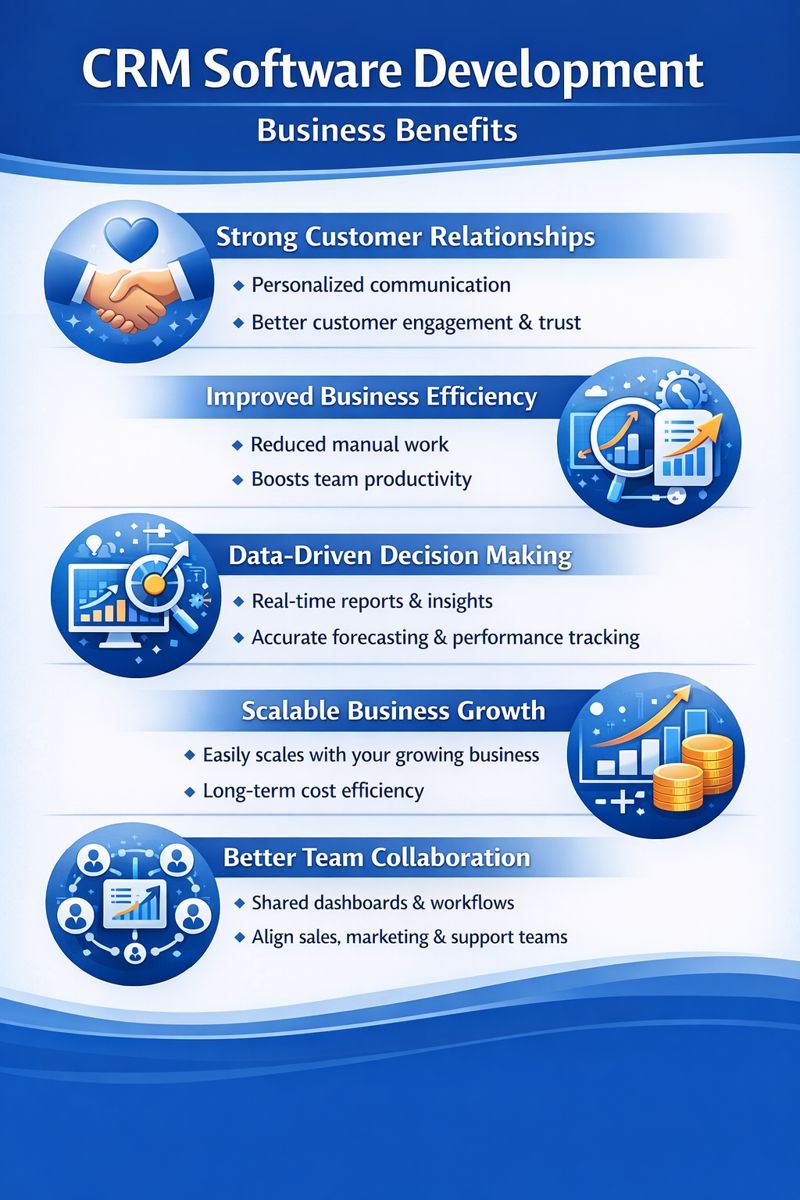
AI has transformed CRM software from data storage tools into intelligent decision engines.
How AI Enhances CRM Systems
- AI-Driven Lead Scoring
- Predictive Sales Forecasting
- Personalized Customer Experiences
- Intelligent Chatbots and Virtual Assistants
- Sentiment Analysis
- eCommerce and retail
- Real estate and property management
- Healthcare and wellness
- Financial services and insurance
- SaaS and technology companies
- Education and training institutes
- Manufacturing and B2B services
- Business-first strategy
- Scalable architecture
- Secure data handling
- AI-driven automation
- Seamless integrations
- Long-term support
- Artificial intelligence
- Predictive analytics
- Voice-enabled CRM
- Low-code and no-code extensions
- Real-time customer data platforms
AI analyzes behavior patterns, engagement history, and demographics to predict which leads are most likely to convert.
Machine learning models analyze historical data to forecast revenue, identify risks, and suggest next best actions.
AI recommends products, content, and offers based on real-time customer behavior.
AI chatbots handle routine inquiries, book appointments, and escalate complex issues to human agents.
AI evaluates customer emails, chats, and feedback to understand emotions and satisfaction levels.
McKinsey reports that AI-driven CRM systems can improve sales conversions by up to 15% and reduce operational costs by 20%.
CRM Software Development Process
Step 1: Discovery and Requirement Analysis
Understanding business processes, users, data flows, and success metrics.
Step 2: CRM Architecture Design
Defining system structure, database models, integrations, and security layers.
Step 3: UI and UX Design
Designing intuitive dashboards and workflows for high user adoption.
Step 4: Development and Integration
Building modules, APIs, third-party integrations, and automation logic.
Step 5: Testing and Quality Assurance
Ensuring performance, security, scalability, and usability.
Step 6: Deployment and Ongoing Optimization
Launching the system and continuously improving it with analytics and feedback.
Industries That Benefit from CRM Software Development
Each industry benefits from tailored workflows, compliance features, and customer engagement strategies.
Why Businesses Choose Aumtec Solutions for CRM Development
At Aumtec Solutions, CRM Software Development focuses on real business outcomes, not just features.
Our approach combines:
We build CRM platforms that evolve as your business grows.
The Future of CRM Software Development
According to IDC, 65% of CRM platforms will embed AI-driven decision engines by 2026, making intelligent CRM development a competitive necessity rather than a luxury.
Conclusion
CRM Software Development is no longer just a technology investment; it is a strategic growth decision. Businesses that invest in intelligent, scalable, and AI-powered CRM systems gain deeper customer insights, stronger relationships, and sustainable competitive advantage.
By aligning people, processes, and data within a custom CRM platform, organizations can transform customer interactions into long-term value.
If your business is ready to move beyond generic tools and build a CRM that truly works for you, CRM Software Development is the next step toward smarter, data-driven growth.