Common Mistakes Store Owners Make While Uploading Products on Shopify: The Ultimate Guide to Avoiding Costly Errors
January 17, 2026
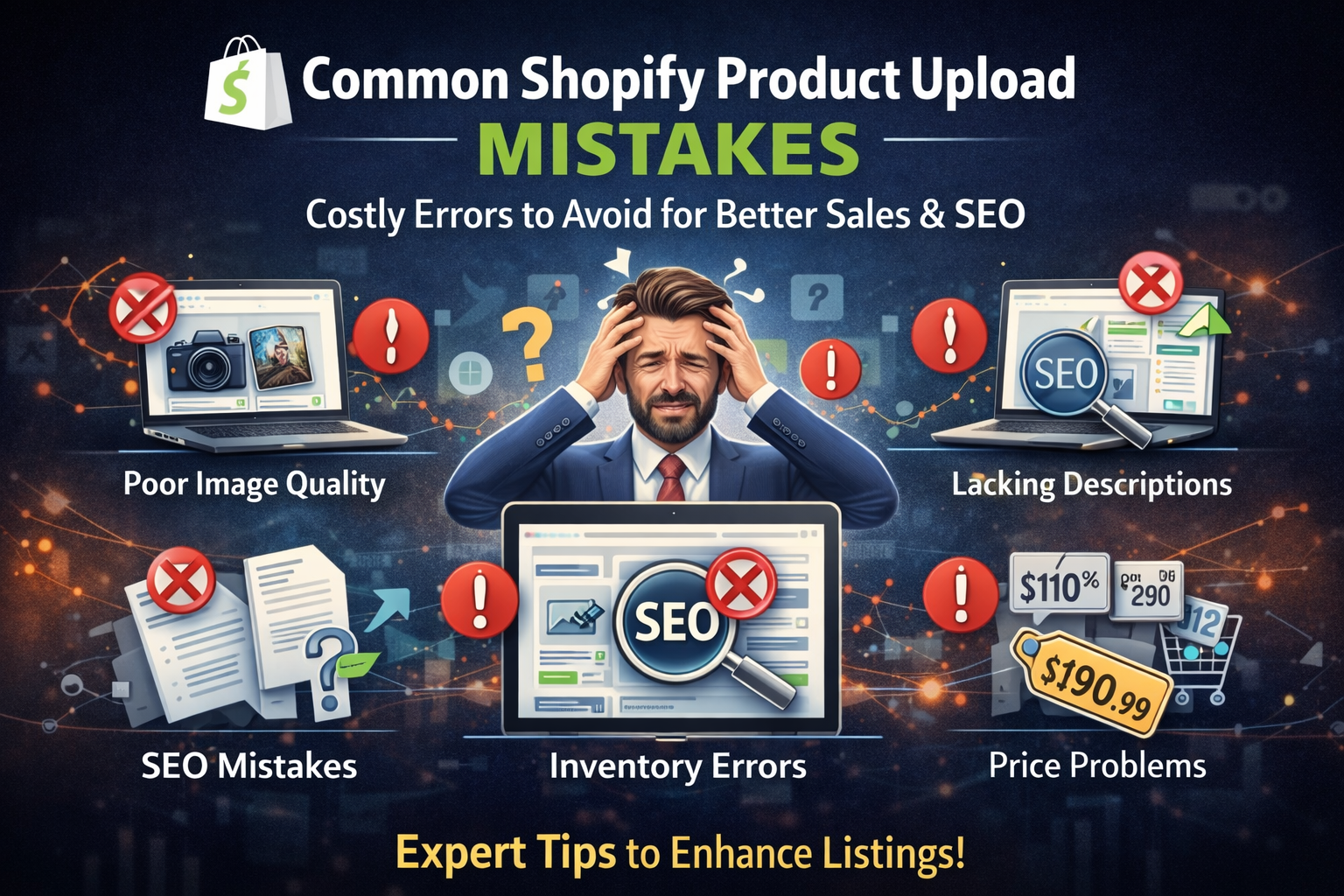
As a Shopify partner who has audited hundreds of stores, I can tell you this with certainty: the difference between a thriving store and a struggling one often lies in the seemingly simple act of uploading products. At Aumtec, we've seen brilliant store owners pour their hearts into sourcing incredible products, only to see them languish unseen because of fundamental, avoidable mistakes made during product upload. This isn't just about data entry; it's about creating compelling digital salesmanship that connects, converts, and climbs search rankings.
In this comprehensive guide, I'll walk you through the most common—and costly—mistakes we see store owners make while uploading products on Shopify, and provide you with the exact strategies to fix them, ensuring your products get the visibility and sales they deserve.
1. The "Blurry Thumbnail" Effect: Neglecting Image Quality & SEO
We live in a visual world. A 2023 Baymard Institute study found that 42% of users base their purchase decision solely on product images. Yet, one of the most frequent errors is uploading low-resolution, poorly lit, or inconsistent images.
What we see: Store owners using manufacturer photos with watermarks, smartphone pictures with cluttered backgrounds, or a single image from one angle.
The Fix:
- Use High-Resolution Images (2048 x 2048px recommended by Shopify): This enables the zoom function, which can increase conversions by up to 9%.
- Follow the 5+ Image Rule: Include front, back, side, detail (texture/close-up), and an in-use or lifestyle shot. Show scale. As one of our clients, Sarah from "The Ceramic Studio," said after a revamp: "Adding a hand holding my mugs was the single biggest change that dropped my return rate to zero—customers finally understood the size."
- Optimize for Speed: Compress images using tools like TinyPNG or Shopify's built-in compression before uploading. A 1-second delay in load time can lead to a 7% reduction in conversions.
- Leverage AI: Use AI tools like Remove.bg for perfect background removal or Adobe Firefly to generate complementary lifestyle scenes or consistent backgrounds for product variations.
2. The Ghost in the Machine: Incomplete & Weak Product Descriptions
Here’s a hard truth: If you only list specs, you're building a catalog, not a store. A product description is your #1 salesperson. The mistake is either writing bare-bones, feature-focused text or, conversely, stuffing it with generic, keyword-spammed fluff.
What we see: Descriptions like "Blue T-Shirt. 100% Cotton. Machine Washable." Or overly salesy prose with no substance.
The Fix:
- Follow the AIDA Framework (Attention, Interest, Desire, Action): Start with a hook that addresses a pain point. Describe the benefits, not just features ("Feel the breathable comfort all day" vs. "100% cotton"). Create a vision of ownership.
- Incorporate Keywords Naturally: Think about what your customer is searching for. Use tools like Google's Keyword Planner or Semrush to find terms like "organic cotton t-shirt for men" and weave them into your narrative. Remember: Google's 2023 guidance prioritizes "people-first" content that demonstrates expertise and experience (EEAT). Write for a human, optimize for the bot.
- Use Scannable Formatting: Bullet points for key specs and benefits. Short paragraphs. Bold text for crucial details.
- Integrate AI as a Collaborative Writer: Use LLMs (Large Language Models) like ChatGPT as a brainstorming partner. Prompt it with: "Generate 5 benefit-oriented bullet points for a [product] that targets [audience], focusing on [key emotion, e.g., comfort, confidence]." Then, you edit, personalize, and add genuine expertise. This aligns perfectly with Google's stance—AI can assist, but the final helpful, human-touched content is what ranks.
3. The Silent Shelf: Ignoring SEO Beyond the Description
Your product page is a landing page for the world. Mistakenly treating the "Search engine listing preview" section in Shopify as an afterthought is a cardinal sin for discoverability.
What we see: Auto-generated titles like "Blue T-Shirt | My Store".
The Fix:
- Craft Compelling Page Titles (Max 60 chars): Use primary keyword + brand. E.g., "Men's Organic Cotton T-Shirt | Sustainable Apparel Co."
- Write Action-Oriented Meta Descriptions (Max 160 chars): This is your ad copy in search results. Include keyword, key benefit, and a call to action. "Shop our ultra-soft, eco-friendly men's organic cotton t-shirts. Designed for comfort & durability. Free shipping on orders over $50."
- Optimize URL Handles: Keep them clean and keyword-rich (/products/mens-organic-cotton-t-shirt).
- Use Alt Text for Every Image: Describe the image for screen readers and search engines. "Man smiling wearing a light blue organic cotton t-shirt in a park" is infinitely better than "IMG_5432.jpg".
4. The Inventory Abyss: Mismanaging Variants, SKUs & Inventory
Disorganization here leads to operational nightmares and customer distrust. Common mistakes include creating separate products for each color/size (hurting SEO) or using meaningless SKUs.
What we see: "SKU: 12345" and 20 separate product pages for "Blue T-Shirt S," "Blue T-Shirt M," etc.
The Fix:
- Use Shopify Variants Wisely: Group colors and sizes under a single parent product. This consolidates reviews and page authority.
- Develop a Logical SKU System: Create a system that tells you about the product at a glance (e.g., TEE-ORG-BLU-M for T-Shirt, Organic, Blue, Medium). This is crucial for scaling and integration with 3PLs.
- Track Inventory Religiously: Set up low-stock alerts. Nothing kills trust faster than selling an "in-stock" item that's on backorder.
5. The Price & Value Paradox
Setting a price is more than cost + margin. The mistake is either pricing too low (devaluing your brand) or too high without justification.
What we see: Round numbers ($20.00) and prices that don't match the perceived value on the page.
The Fix:
- Price Psychologically: Use charm pricing ($19.99 or $197) which is proven to be effective.
- Show Value Clearly: If your t-shirt is $45, your descriptions, images, and story must scream why it's worth three times the fast-fashion alternative.
- Be Transparent: Clearly display shipping costs, taxes, and return policies upfront to avoid cart abandonment.
6. The Forgotten Journey: Neglecting Collections & Navigation
A product page is not an island. Failing to integrate it into your store's ecosystem is a missed opportunity for cross-selling and longer sessions.
What we see: Products not added to relevant collections, or "related products" sections showing irrelevant items.
The Fix:
- Create Strategic Collections: Use automated conditions (product tag contains "summer") and manual curation for bestsellers. Think like a curator.
- Leverage Apps for Upselling: Use apps like Frequently Bought Together or Cross-Sell to create product bundles intelligently.
- Guide the Next Step: Ensure your "Add to Cart" button is prominent and consider adding a "Complete the Look" section.
AI Integration: Your Co-Pilot, Not Your Autopilot
The landscape is evolving. At Aumtec, we strategically use AI to enhance—not replace—the human touch. Here’s how:
- Content Brainstorming & Structuring: As mentioned, LLMs can overcome writer's block.
- Image Optimization: AI tools can upscale old images, generate variant mockups (e.g., showing a bag in 20 colors without a photoshoot), and ensure visual consistency.
- Data Enrichment: AI can help clean and format bulk product data from spreadsheets before import.
- SEO Analysis: Tools like Frase or MarketMuse use AI to analyze your content against top-ranking pages and suggest improvements.
Crucially, we always apply our expertise, brand voice, and real-world experience to this AI-generated foundation. This creates the helpful, reliable, people-first content that Google rewards.
FAQs: Shopify Product Upload Mistakes
The Bottom Line: Uploading a product on Shopify is an act of creation. You're building a digital touchpoint that must inform, persuade, and instill trust. By avoiding these common mistakes—by investing in stunning visuals, crafting compelling narratives, mastering the technical SEO essentials, and leveraging smart tools—you transform a mere listing into a powerful sales engine.
At Aumtec Solutions, we help store owners navigate this complexity every day. We don't just build stores; we build optimized, conversion-focused digital experiences. If you're looking to audit your existing product pages or launch a new collection with a strategy designed to rank and convert, let's talk. Your products deserve to be seen.